Gross vs. Net Salary in Belgium: Why a Higher Salary Doesn’t Always Mean a Better Offer

When considering a new career opportunity, salary is almost always part of the conversation. But in Belgium, comparing compensation packages is becoming increasingly complex.
A higher gross salary doesn’t necessarily mean a better financial outcome. Sometimes, an attractive compensation package can even make it harder to change jobs.
At Skill&Will, we increasingly encounter this reality in our daily conversations with candidates and employers.
Does Gross Salary Still Matter?
We recently asked our LinkedIn network a simple question:
“Does fixed gross salary still play a role in your decision when evaluating a salary proposal?”
The results were interesting:
- 58% indicated that gross salary still matters.
- 41% focused on the total compensation package.
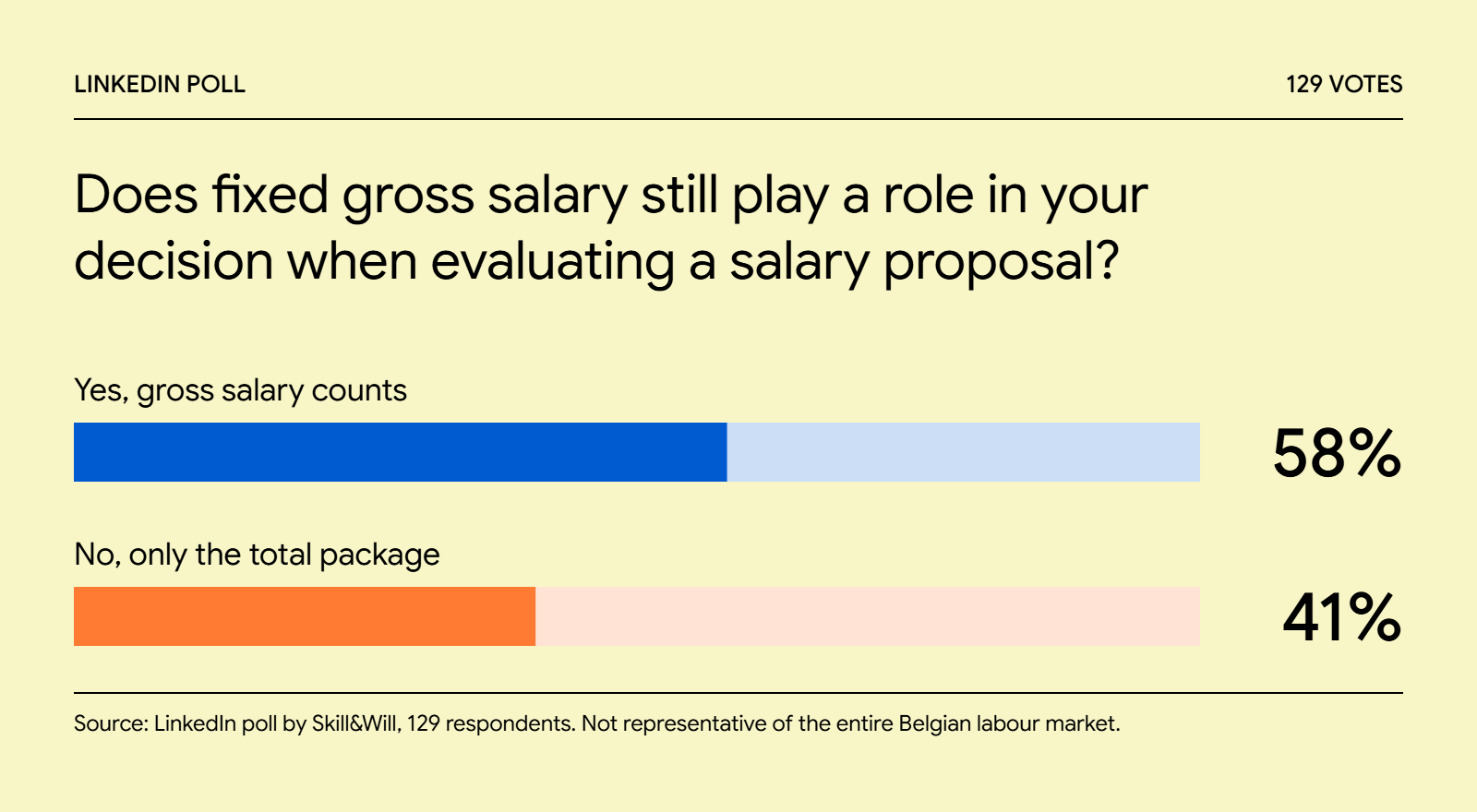
With 129 professionals participating, the poll offers an interesting perspective, although it is not representative of the entire Belgian labour market.
Despite the growing importance of tax-efficient benefits, fixed gross salary clearly remains relevant.
But our daily experience suggests that the reality is more nuanced.
Different Generations, Different Priorities
One thing we notice at Skill&Will is that compensation expectations often differ between generations and career stages.
Younger professionals may focus more on immediate purchasing power and monthly net income. More experienced candidates may attach greater importance to fixed gross salary, financial security or long-term benefits.
Others prioritize flexibility, additional holidays or work-life balance.
Of course, these preferences are not strictly defined by age. Personal circumstances and career ambitions play an equally important role.
The same compensation package can therefore be perceived very differently depending on the candidate.
And that makes salary negotiations increasingly challenging.
The Mobility Budget: An Unexpected Barrier to Changing Jobs?
An interesting example is Belgium’s mobility budget.
Under specific conditions, employees can use their mobility budget to finance housing expenses, such as rent or mortgage repayments. This can be particularly attractive for professionals living within 10 kilometres of their normal workplace or meeting the applicable teleworking conditions.
These eligible expenses can be financed in a tax-efficient way, significantly influencing disposable income.
And this is where we increasingly encounter an interesting challenge.
Candidates can be genuinely interested in a new opportunity but find it financially difficult to make the move.
Imagine a professional using €700 per month from an eligible mobility budget to cover housing expenses.
When changing employers, that advantage may disappear if the new company does not offer a comparable arrangement.
Even a higher gross salary might not fully compensate for the loss in purchasing power.
This creates an interesting paradox.
Companies introduce attractive compensation structures to attract and retain talent. Yet those same structures may unintentionally make employees less willing to consider new opportunities.
Sometimes, candidates are not staying because they lack ambition. They are staying because leaving comes at a financial cost.
Why Smaller SMEs Should Pay Attention
This evolution creates an additional challenge for Belgian employers, particularly smaller SMEs.
The Belgian government is planning a phased introduction of the mandatory mobility budget offer for eligible employees, starting with companies employing at least 50 people in January 2027, followed by companies with 15 to 49 employees in January 2028. Companies with fewer than 15 employees are expected to remain exempt.
While the legislation is still being finalized, mobility budgets could become an increasingly important element of compensation discussions.
And this is particularly relevant for smaller companies.
When competing for talent with larger organizations, offering a competitive gross salary may no longer be enough.
Candidates who currently benefit from a mobility budget may find it financially unattractive to move to an employer that cannot offer a comparable arrangement.
Rather than waiting for legislation or market pressure, smaller SMEs could already explore whether introducing a mobility budget makes sense within their compensation strategy, provided they meet the legal eligibility requirements.
Being a smaller company should not automatically mean competing with fewer tools when attracting talent.
A Conversation Worth Continuing
Our LinkedIn poll suggests that gross salary still matters. But our daily conversations reveal a more complex picture.
Different generations, personal circumstances and increasingly flexible compensation structures all influence career decisions.
The mobility budget is just one example of how financial advantages can affect professional mobility.
It also raises questions worth exploring further. How often do candidates decline opportunities because of the net financial impact? And how can employers better anticipate these situations?
Further research is needed to understand the scale of these effects.
At Skill&Will, we believe the real challenge is no longer simply offering a competitive salary. It is understanding what competitive actually means to each individual.
For smaller SMEs, anticipating these developments today could make a real difference in attracting talent tomorrow.
Because the right career move should make sense professionally, personally and financially.
